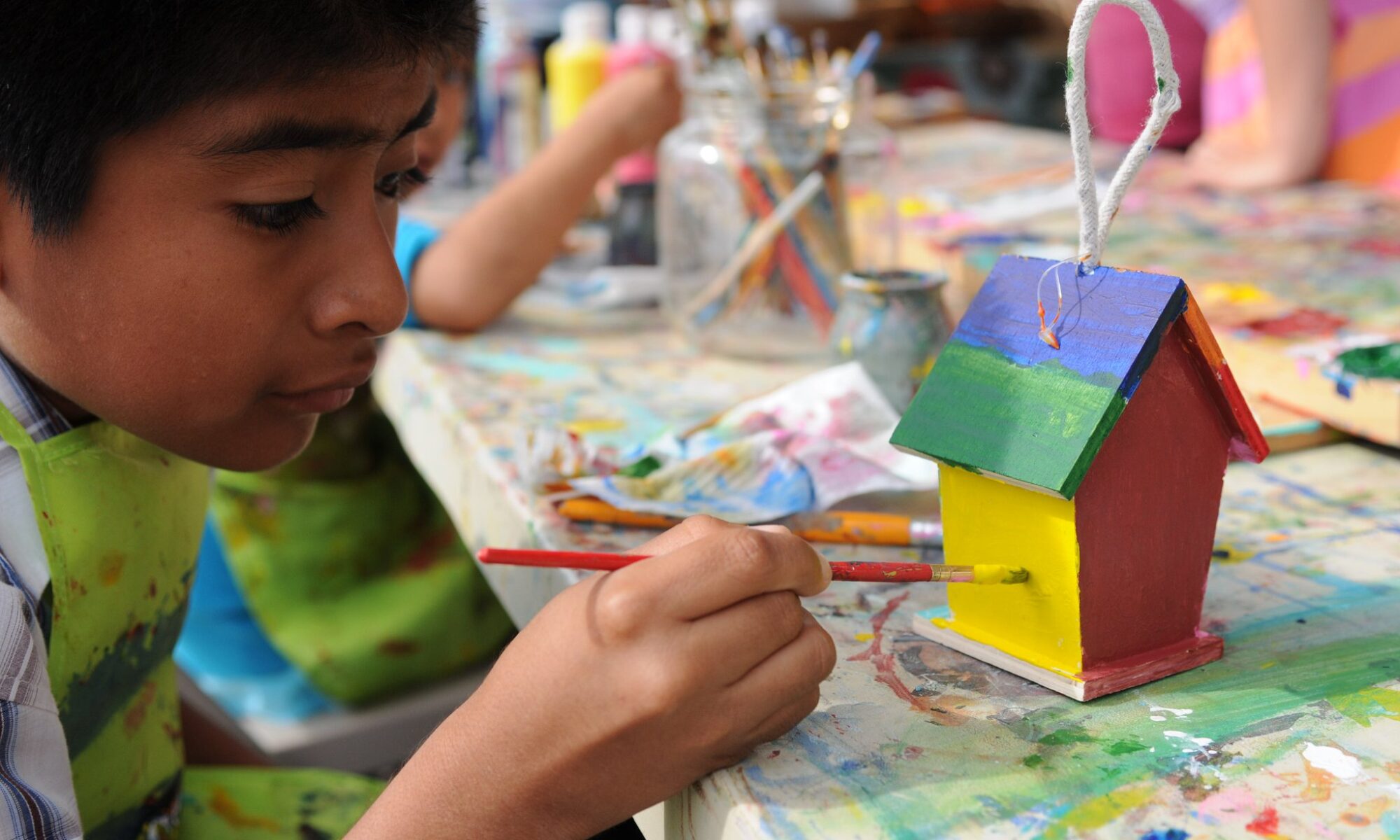


Whether you are a first-year art teacher, a homeschooling parent, or a school administrator, building an art program from the ground up can feel incredibly daunting. When faced with empty shelves and an empty calendar, it’s easy to feel overwhelmed by projects, messy cleanups, and supply lists. I remember feeling this exact way when I started my art classes 30 years ago!
However, a successful visual arts program isn’t built on random holiday crafts or one-off projects. It requires a predictable, sustainable framework that scaffolds a child’s natural developmental abilities. And that’s what I learned through those years of teaching children of all ages.

How to Build a Sustainable Art Program
An effective childhood art program requires a shift from “product-driven” activities (where every child makes the exact same copycat craft) to process-based art literacy. A strong visual arts program has a recognizable quality. Children move through it with growing confidence. Their work deepens over time. Teachers feel prepared, not reactive.
That quality doesn’t come from collecting great project ideas. It comes from structure. A program that’s built on developmental sequence — where each experience prepares a child for the next — looks and feels different from one that isn’t. Children stay engaged longer. They return to materials willingly. They begin to make decisions on their own.
That’s the difference between a program and a collection of activities. One is designed. The other is assembled.

Designing Around Some Essetial Art Domains of Art Literacy
When building an art program, visual arts instruction should be divided into core, digestible pillars. This keeps your planning organized and ensures children develop fine motor skills and spatial awareness naturally over time.
A comprehensive K-6 grade art program should cycle through these foundational pillars:
- Drawing & Sketching: Learning the basic elements of lines and shapes as the building blocks for visual communication.
- Painting & Color Exploration: Understanding color mixing and theory through hands-on application, rather than static lectures.
- 3D Sculpture: Developing spatial awareness, hand strength, and tactile coordination.
- Crafting : Utilizing basic engineering, structural thinking, and mixed media.

Turnkey Solutions for Building Your Art Program
You don’t have to design a sequential visual arts syllabus from scratch or guess which skills matter next. Nature of Art® offers fully scaffolded, child-tested curriculums designed to save you time and eliminate lesson prep stress.
Below you will find seveal free art program blogs I have created to answer all your questions and direct you to the right information for preparing your art program. You can also check out my done for you curriculums you can purchase.
Start Building Your Program Today
Building an art program doesn’t require you to be a professional artist. It simply requires a reliable structure where children feel safe to experiment, make adjustments, and learn from unexpected results.
Explore our collection of foundational books, open-and-go curriculums, and professional training blueprints to give your students a sustainable, rich visual arts journey.

Developmental art curriculums rooted in the Science Art Method™
Painting Curriculum
57 sequential brushstroke lessons that build real painting skills — from basic strokes to complex compositions. Designed for process-based art learning.
Explore Curriculum → CurriculumColor Theory Curriculum
37 hands-on color mixing lessons grounded in the science of color. Children discover how colors work, blend, and relate — not just which colors are “pretty.”
Explore Curriculum → CurriculumClay Modeling Curriculum
27 structured clay lessons that develop fine motor skills and three-dimensional thinking. A sensory-rich, developmentally appropriate approach to sculpture.
Explore Curriculum → CurriculumDrawing Curriculum
Sequential drawing lessons spanning Early Childhood and Elementary levels. Builds observation skills, line control, and visual literacy from the ground up.
Explore Curriculum → CurriculumCrafting & Building Curriculum
Purposeful making with real materials. Children design, construct, and problem-solve — connecting art to engineering thinking in a structured, joyful framework.
Explore Curriculum → Professional TrainingArt Teaching Blueprint™
A professional certification for educators who want to teach visual arts with developmental clarity. 60+ video lessons, live coaching, and up to 50 CPD hours. Enrollment opens May & November.
Learn About Training →Frequently Asked Questions About Building an Art Program
Q: What is the first step to building a visual arts program from scratch?
The first step to building a sustainable visual arts program is establishing a sequential, grade-level scope and sequence. Rather than assigning random, disconnected art ideas, a successful program focuses on teaching foundational art literacy elements, such as line, shape, or color theory, that progressively build a child’s fine motor skills and creative confidence over time.
Q: How do you design a comprehensive K-8 art curriculum?
A comprehensive K-8 art curriculum should be structured around core visual arts areas rather than individual, one-off projects. A balanced curriculum cycles students through drawing, painting, color exploration, and tactile art proects. Turnkey art lesson plans, like the Nature of Art® K-8 Art Curriculum, provide open-and-go lesson tracks that eliminate prep stress while meeting national visual arts standards.
Q: What are the essential art supplies needed to start an elementary art program?
The most important quality in any foundational art supply is this: it should allow a child to focus on one skill at a time. When materials are too complex, too unpredictable, or simply low-quality, children spend their energy managing the medium rather than developing skill sets.
Start small. Choose child-tested mediums that are developmentally appropriate for your age group. Fewer materials used well will always produce stronger results than a full shelf used poorly. For specific supply guidance, the free painting checklist is a good place to begin. Or check out my early childhood or elementary art guides with full art supply list.
Q: Can a classroom teacher lead an art program without an art degree?
Yes. You do not need to be a professional studio artist to build a thriving classroom art program. With structured professional development, such as the Art Teaching Blueprint Certification course , general education teachers and homeschool parents can quickly learn how to teach art literacy, manage classroom cleanups, and guide process-based art lessons with total confidence.
Q: What is the difference between process-based art and product-driven art?
Product-driven art focuses on a rigid, identical end result—like a classroom where every child creates the exact same copycat holiday craft. Process-based art focuses on art literacy, exploration, and critical thinking. In a process-based program, children learn how to handle mediums and express their own visual ideas, meaning every child’s finished artwork looks unique, authentic, and personally meaningful.

About the Author: Spramani Elaun is a professional artist, author of 10 books on early childhood and elementary art education, and founder of Nature of Art®. She holds degrees in Fine Arts, Graphic Design, Digital Media, Print Media, and Business, and has spent over two decades developing the Science Art Method™. She trains Montessori schools and independent educators worldwide.
All rights reserved © 2026, Nature of Art®

Nature of Art® provides art pedagogy
This website and its blogs supports individual educators in teaching children visual arts. It does not authorize professional development, staff training, or adaptation of the Science Art Method™ for institutional use.
No part of this blog may be used or be reproduced in any manner whatsoever including reproducing, publishing, performing, and making any adaptions of the work – including translation into another foreign language without written permission except in the case of brief quotations embodied in critical articles and reviews.
Nature of Art® Publishing P.O. Box 443 Solana Beach, California 92075.
About The Author

One Reply to “Building an Art Program from Scratch: The Complete Step-by-Step Guide”
Comments are closed.