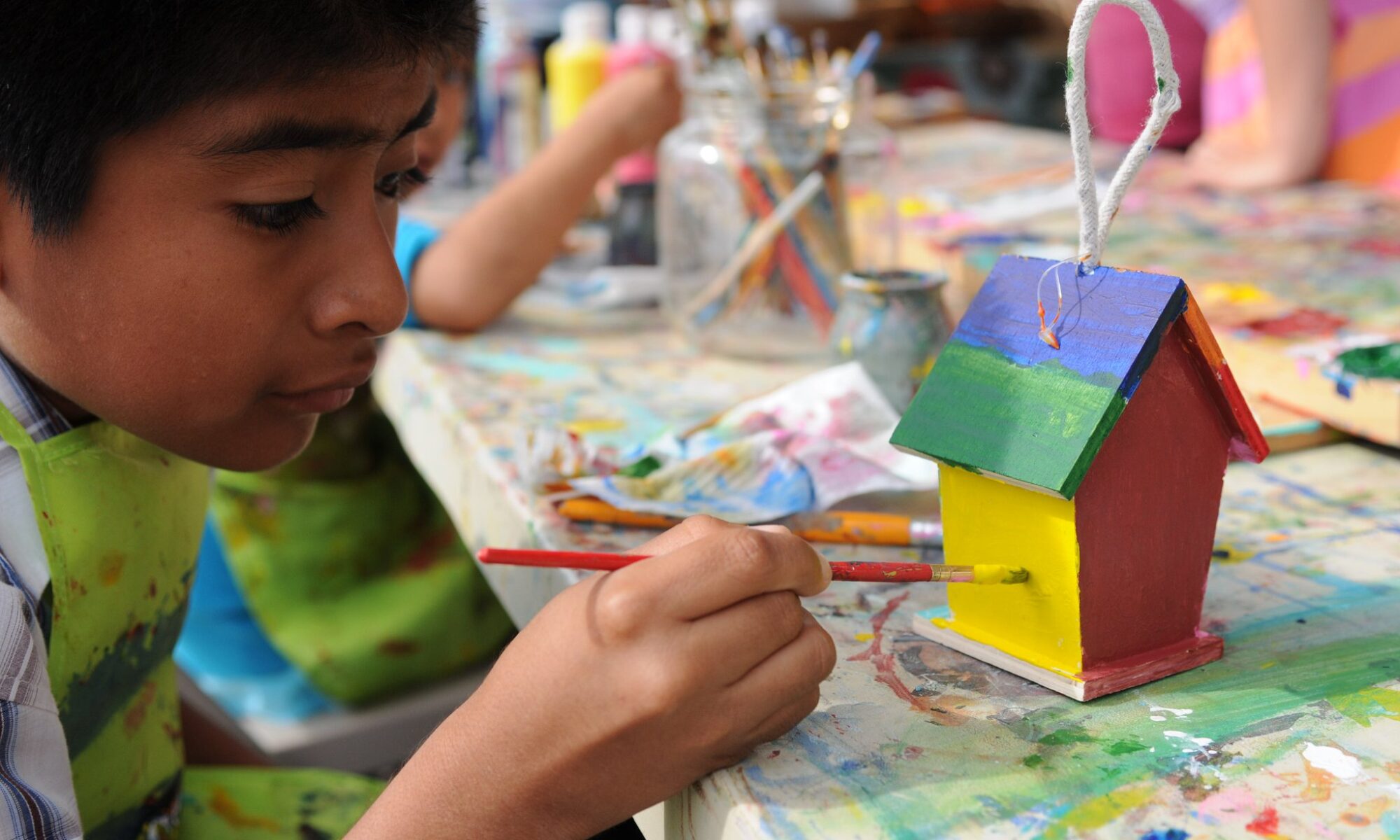

By Spramani Elaun
In honor of Earth Day I’ve decided to share my 5 earth-friendly art painting projects I host annually at some of the largest Earth Day celebrations on the West Coast.
1. City of Trash – construct a city out of your own daily waste and paint.
2. Sticks n’ Stones – paint rocks with eco –friendly acrylic paint.
3. Paper Roll Sharks – recycle paper rolls into cute sharks, paint and embellish.
4. Upcycled Canvas – paint on recycled cardboard.
5. Paint Veggie – paint cute funny faces and embellish with up cycled scraps.

Project 1.
City of Trash Earth Day Project For Children
City of Trash is a collaborative recycled cardboard art project I created for one of the largest Annual Earth Day Events held at Balboa Park in San Diego, California. City of Trash was my way of showing children how one household can produce an abundance of non-biodegradable waste weekly, and an opportunity to educate them about our landfill issues.
The art project structure started with me challenging a group of children to save one week’s worth of trash from shopping trips to the grocery store with their families. I asked them to save everything that would normally go into the trash or recycle bin – minus perishable items. I took the challenge myself and saved all of my shopping containers for one week, “See picture below”.
After collecting a week’s worth of garbage, I set out to start constructing City of Trash. I guided the children with simple ideas of building features usually found around city landscapes. I found an extra-large cardboard box and recycled it into our flat canvas to build onto. I started the basic constructing of tall buildings and the kids jumped right in with some really cool and creative ideas of their own.
Once the city was constructed, the second phase of painting than started.” The second phase was a great opportunity for me to teach a painting lesson to the kids. We used earth-friendly, safe and non-toxic acrylic paints on this project.
The City of Trash upcycled structure below was on display and open to the community to view at the EarthWorks Earth Day Festival in San Diego. Our City of Trash was captured on camera by several local network T.V. channels. I also had the opportunity to host the same type of project with local homeschooling organizations. The earth-friendly message behind this art project is to remind consumers of their buying habits and the landfill issues we face today.
The earth-friendly message behind this art project is to remind consumers of their buying habits and the landfill issues we face today.
Trash we collected was packaging scraps commonly recycled or discarded. This low-cost project can be re-created for kids to make as an Earth Day project. Listed below are simple suggestions for making this project at home, in classrooms or with organized groups such as boy or girl scouts. Boy or girl scouts can earn a badge or patch for learning about what “earth friendly” means.
How to make this recycled project:
• Collect trash, cardboard, boxes, and anything that cannot biodegrade quickly or that commonly goes into the recycle bin.
• Good scissors
• Glue gun – low temperature glue gun (parents should help with glue gun
• Non-toxic paints
• Paint brushes
• Duct tape or clear strong tape

Project 2.
Sticks n’ Stones Recycled Painting
This signature earth-friendly art activity made waves around San Diego communities and has traveled to major Green Festivals, Earth Day Events, Museums and Educational Venues all over the West managed by my company Nature of Art For Kids®.
It started on the 101 beach road in San Diego at a local beach community farmer‘s market in Encinitas, California. I wanted to create an art project with kids that was 100% sustainable to for the environment. I searched for the most earth-friendly surfaces to paint, found natural earth elements like rocks and sticks, then searched for the most earth-friendly paints to paint them with. I
t was a difficult mission for me to find a truly earth-friendly paint that would stick to the surfaces of a rock and was safe for kids to use. Around that same time the idea of my new company was born, the first ever non-toxic, safe, and earth-friendly acrylic paints just for kids store.ecokidsart.com.
It took me years to bring a safe, U.S. Made acrylic paint just for kids to market. After the manufacturing of my earth-friendly acrylic paint I started to appear all over California with my Sticks n’ Stones earth-friendly art project.
Sticks n’ Stones has been featured at some of the most earth-friendly events in the nation, such as Cardiff Green Festival, Green Fest, Earth Day Festivals, Organic Farm events, Original Harvest Craft Festival and the largest Pumpkin Festival on the West Coast.
The idea is simple – use a surface that is not man-made, can be found in nature, and is safe to use. Use Earth’s natural resources! Use a paint that is safe for the environment and for small children.
Setting up kids to paint rocks
Acrylic Kids Paint – We use Nature of Art For Kids® Earth Friendly Acrylic Paint
Palette
Paint Brushes
Napkins
Water Jar
Rocks
River rocks or any stone of any shape will work. I like river rocks because they seem to have the flattest surface to paint an image on.
Wipe your rocks clean by washing them in water.
Completely dry rock before painting.
Prepare a palette filled with a variety of colors children can choose from. A paper plate, or recycled egg carton can also work as a palette to hold paints.
Having a tiny, medium, and large, wide paint brush available is perfect for all brush stroke desires. If you don’t have all three that’s OK, one medium-sized paint brush works well with kids.
Tip: Paint each layer of color and set aside to dry.
Painting one layer coat of paint at a time gives better results. Set your rock aside to dry for a few minutes before you add a new layer of color.
Rocks dry best when left in direct sunlight.


Project 3.
Paper Roll Shark Painting Recycle Project
A simple recycled paper roll can transform into a water shark kids will delight in making. It is a inexpensive craft project and easy to manage with young to middle-aged kids. Save money by using materials you already have and save trees! This project was inspired by one of my young art students who loves sharks. I went to my creative team to figure out an eco-friendly shark art project. Presto…. paper roll sharks!
How to Make Paper Roll Sharks
• Recycled Paper Rolls
• Kids Paints – We use Nature of Art For Kids® Earth Friendly Acrylic Paint All types of paint can work for this art project.
• Eyes googly eyes, fabric scraps or buttons can be used)
• Paint brush – wide
• Paint palette
• Water jar
• Napkins
• Scissors
• Glue
• Shark template shape
Materials Tips:
Acrylic works best on paper rolls, giving a nice opaque coverage over cardboard.
Large, wide paint brushes work best for this project.
Sponge type brushes can also work well to paint sharks. A painter’s palette or egg carton will work best to hold paints.
Water jar for dipping and cleaning brushes in between colors.
Napkins for paint brush clean-up or messy hands.
Baby wipes are awesome for cleaning messy hands with paint on them.
Cut template pattern out, place on top of flattened paper roll and trace. Be sure your paper roll is flattened for easy tracing.
Anything will work for tracing, whether it’s a pencil, marker, or crayon, since he tracing marks will be trimmed and painted away.
Once shape is traced, trim shape out with scissors and unflatten the paper roll, popping it back into a roll shape.
Shark template
Cut template pattern out, place on top of flattened paper roll and trace. Be sure your paper roll is flattened for easy tracing.
Anything will work for tracing, whether it’s a pencil, marker, or crayon, since he tracing marks will be trimmed and painted away.
Once shape is traced, trim shape out with scissors and unflatten the paper roll, popping it back into a roll shape.
Fin making tips:
Use scraps to make a fin shape for a shark or fish creature.
Glue fins on with glue or a glue gun.
I‘ve found that it’s easier and I can get sturdier results if I cut a slit in the roll, and place the fin inside, and glue it to secure the fin in place.
This helps the sharks fin last longer and stay in place while kids have fun playing with their sharks.
Teeth making tips:
You can make sharp teeth by drawing them ahead of the time on paper roll or just cutting them out free-hand.
Kids can also just paint or draw on teeth with using white paint.
Eyes
Glue eyes on with children’s glue or a glue gun
2. Set the environment
• A space to get messy
• Good lighting
• Flat work-station
• Materials
• Smock or clothes that can get messy
It’s important to have a place children can get messy that will with stand messy spills.
It’s important to set up in a place children can get messy.
Be sure table and chairs are at the level of the child.
Materials should be easy for children to reach during project making.
3. Child-led and adjustable for all ages
This project can be achieved by many different skill levels and easily adjusted for toddler to middle aged kids. (Read more about this fame work n my new book, Nurturing Children In The Visual Arts Naturally©). (Read more about this fame work in my new book)
Paper roll prep for young children:
I recommend cutting sharks out ahead of time for kids under 5 years or kids not using scissors yet. Kids can paint and embellish with ease if the shapes are cut out ahead of the time.
Tracing and cutting (out templates) can work well with older kids(*).
Allow independent kids to trace and cut out (their) shark(s) themselves.
If your kids are fine motor capable then this is great for them.
Be sure to have plenty of extras (extra) paper rolls for (replace “for” with “in case of”) mistakes.
Young kids cutting out their own templates will need time to understand how the template pattern works by tracing and cutting it out with practice.
4. Exploration Time
The most important part of this project is allowing children time to explore and construct this project with their own hands.
Older children will usually spend more time painting and embellishing their creatures.
Mature students usually try different shapes other than sharks designs.
For this project I recommend 15-30 minutes for younger children and 40 minutes -1 hour for older children.
The common process you can expect for these ages is:
15 months – 6 years: Children will learn to dip brushes into paint, learn to make brush strokes, play in palettes and mix paints, swish water around in jars, learn to spread paint over sharks and delight in the process. Most areas on the shark will not be covered completely. Using hands in paints and exploring by covering the art or table in paint) s common. This is all perfectly normal.
6 – 9 years old: Children will want to make their sharks unique and spend time exploring how the fins can create a different look on each shark.
Children of these ages quickly learn how to use materials and don’t need to be guided in the process of making. Only one or two demonstrations is necessary.
10 – 15 years old: Children will enjoy the mixed-media aspect of this project and create many different versions. Students at this level will spend careful time planning designs. These students can work independently and for longer durations of time.
No part of this blog may be used or reproduced in any manner whatsoever without written permission except in the case of brief quotations embodied in critical articles and reviews.
Kids Paint Recycled Cardboard Art Projects
By Spramani Elaun
Children love painting on cardboard. It is sturdy, forgiving, inexpensive, and perfect for practicing painting techniques without the pressure of using costly art surfaces.
As an art teacher, I use cardboard regularly for painting activities. It allows children to work freely, revisit surfaces multiple times, and explore large-scale ideas without concern.

Why Use Recycled Cardboard?
Painting on recycled cardboard is not only practical, it is environmentally responsible. Reusing cardboard helps reduce waste and conserves resources such as water, energy, and raw materials.
Using cardboard also reduces reliance on newly manufactured art surfaces. Many paper products depend on cotton cultivation, which involves heavy water use and chemical processing. Choosing recycled materials is one simple way to lessen environmental impact.
Read how to here: https://www.ecokidsart.com/tag/cardboard-canvas-for-kids/
Veggies Can Make Natural, Safe Paint for Kids

By Spramani Elaun
Many parents ask me the same important question: What is the safest paint for toddlers?
My best advice, especially during the early toddler years, is simple: make your own vegetable paint at home.
When babies transition into toddlerhood, they explore the world with their mouths. Everything gets tasted. Even though many art paints are labeled non-toxic, they are still not intended to be eaten. Vegetable-based paint offers a gentle, reassuring alternative during this stage of development.
Homemade veggie paint is safe, easy to make, and perfect for first-time painters. It also connects children to nature and introduces art in the most natural way possible.

What “Natural Paint” Really Means
Natural vegetable paints are made from pigments found in fruits, vegetables, leaves, flowers, seeds, or roots. These pigments have been used for thousands of years, including in early cave paintings.
A few important notes for parents:
- Some commercial “natural” paints still include preservatives for shelf life
- There is currently no U.S. seal regulating natural art products
- Always read ingredient lists carefully
- Even natural pigments may cause irritation for children with sensitivities
Homemade vegetable paint keeps ingredients simple and transparent—perfect for young children.
Read Full How To Blog Here: https://www.ecokidsart.com/naturalsafepaint/

Kids Painting: Teach young kids how to paint, materials & set-up guide
by Spramani Elaun (Author)
ISBN-13 : 978-0991626410
A Short Cut Just for You
If you’d like more support for getting children started with painting, including materials guidance and age-friendly ideas, you can find more in my book Kids Painting by Spramani Elaun.
The ideas shared here are intended for classroom or home use with children. They are not intended as teacher-training instruction, certification guidance, or a reproducible training curriculum


All rights reserved © 2026, Nature of Art®

Nature of Art® provides art pedagogy
This website and its blogs supports individual educators in teaching children visual arts. It does not authorize professional development, staff training, or adaptation of the Science Art Method™ for institutional use.
No part of this blog may be used or be reproduced in any manner whatsoever including reproducing, publishing, performing, and making any adaptions of the work – including translation into another foreign language without written permission except in the case of brief quotations embodied in critical articles and reviews.
Nature of Art® Publishing P.O. Box 443 Solana Beach, California 92075.